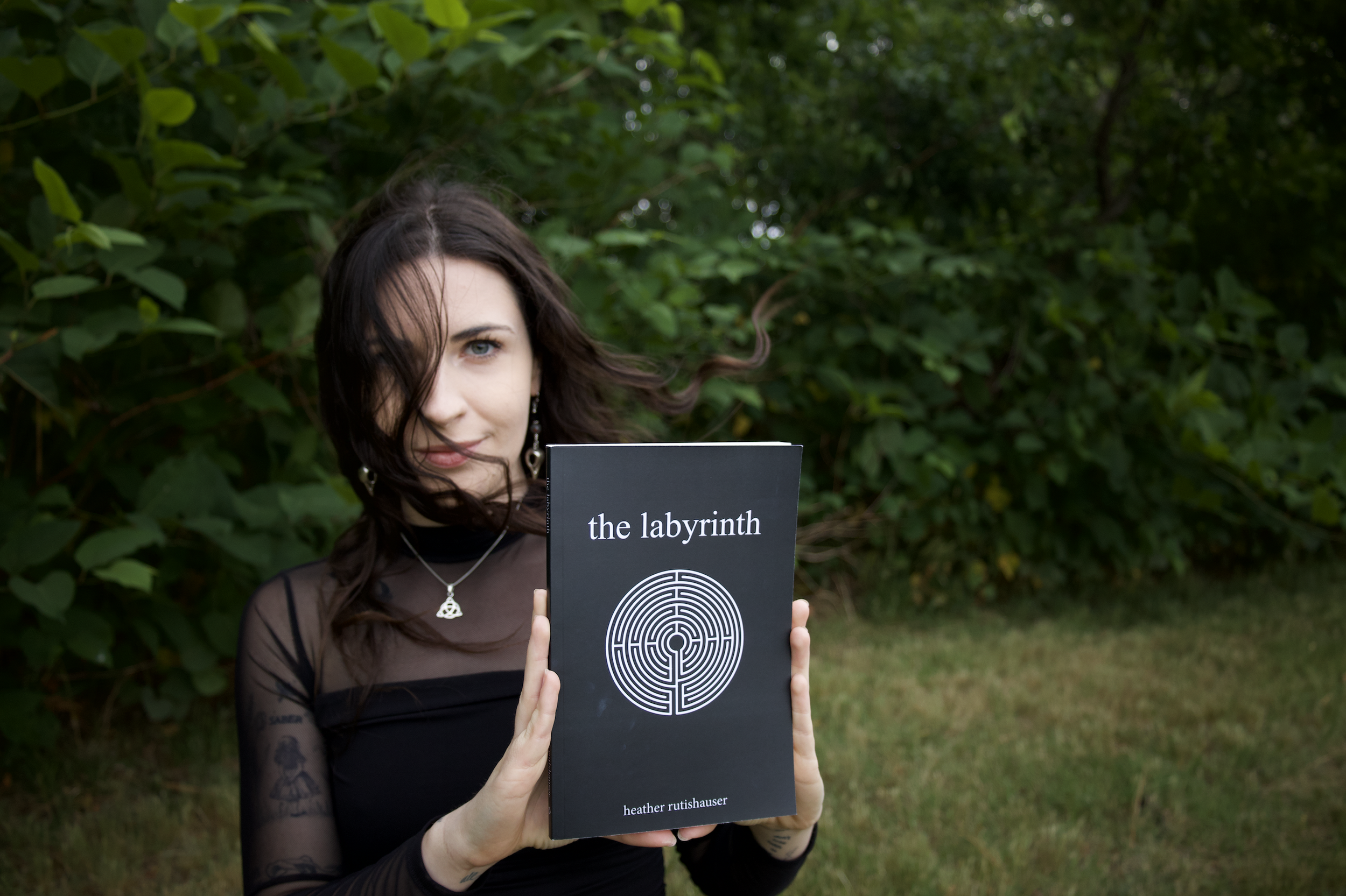
the labyrinth

The poetry collection of a girl lost in the labyrinth of suffering that was her mind. She picked up a pen and wrote her way out.

Pen name: Heather Rutishauser

artist statement

The labyrinth is a motif that has haunted me throughout my entire adulthood. I have author John Green to thank for that. When I was 17, I read Looking For Alaska—his book about a teenage boy navigating grief. The pinnacle question posed throughout the book was:

“How will we ever get out of this labyrinth of suffering?”

Despite having what I believed to be a fairly normal teenage life at the time, I remember being profoundly altered by that book and that question. The concept of the labyrinth remained in the back of my mind. But still, it was just a book. Or so I thought.

A year later my mom passed away as I started college, and my world was forever changed. I navigated severe anxiety and depression while trying to make it through school. This one single event had triggered a complete unraveling of everything I had ever believed about life and what mine would look like. The illusion of happiness had shattered. I couldn’t help but think back to that John Green book often, and realize that it wasn’t just a book anymore. For me, real life had become a labyrinth of suffering.

This labyrinth continued to twist and turn in completely unexpected and uncontrollable ways. My college years were laden with multiple displacements and traumatic living situations, as well as a global pandemic. After college, discovering I was neurodivergent led to a reprocessing of my entire past and all my relationships.

Eventually a light emerged. A year later I began the spiritual journey, which led to new magical situations and adventures I would have never expected. I began slowly breaking trauma patterns to become someone I actually liked in the mirror. I wrote a memoir about this time in my life, Break Free: How Following the Signs Led Me to Myself. Feel free to look it up if you’re searching for a magical story.

After the events of that book, I went on to solo travel nomadically for nearly two years, while working as a spiritual guide for others and focusing on the book’s publication. Break Free was published in the beginning of 2025, solidifying my childhood dream of becoming an author, and I truly believed that—equipped with a deeper understanding of myself and the magic of the universe—my labyrinth of suffering was finally over.

But as 2025 progressed, it all came crashing down again. Worsening chronic illness forced me to stop traveling, stop my work, and return to the US to live with people from my past. I watched my entire life get stripped away before my eyes, because I no longer had the capacity to live it. At the same time, being put back in situations that mirrored bad memories unearthed many dark emotions I thought I had already processed.

I had nothing left. I had no concept of a future. I was being drowned by my past. My body was failing me in the present. I was sitting at a complete dead-end to this labyrinth. I called a suicide hotline for the very first time—a last resort I had never turned to in all my years of mental suffering.

It was in this exact moment, where not a single thing was left to hold on to, that a lifeline emerged. One day as my emotions once again threatened to devour me, a string of words floated into my head. I pulled out my journal and began writing a poem.

I spent maybe an hour or so in a trancelike state, words flowing onto page. And when it was over, a curious thing happened. My emotions now lived on the page rather than in my head. A few days later I filmed myself reciting the poem as spoken word, as all my poetry is written with the intention to be spoken in rhythm. During the performance, I felt these emotions flow through me one last time, and then finally release. Afterwards I felt energetically integrated, lighter, and ready to move on.

That was the day I realized that my old emotions didn’t just need to be felt, they needed somewhere new to live. They were an energy that needed to be funneled into creation,so that they would no longer consume my mind. And that was the day I fell in love with poetry.

From that day forward, whenever I began to have really strong emotions, I channeled them into poetry. And—akin to Theseus in Greek mythology, who followed Ariadne’s thread to find his way out of the Minotaur’s labyrinth—I followed my pen and began to write my way out. I began to write my way out of the labyrinth of suffering.

Each poem in this collection stands on its own, but you’ll find that if you read through them in order, a larger narrative emerges—a girl with her entire life crashing down around her, navigating through the never-ending labyrinth of emotions spurned by grief, love, and loss.

And right when she believes she’s hit rock bottom, she finds—like the last spirit left sitting in Pandora’s Box, looking to finally be set free—one last emotion waiting to be released:

Hope